IPF: The International Powerlifting Federation
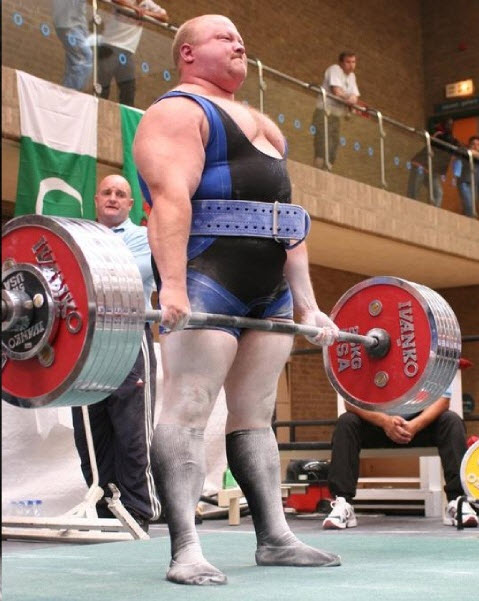
Dean Bowring in IPF competition gear at the 2005 Commonwealth Powerlifting Championships. The IPF is the federation most associated with strict judging, single-ply equipment, and year-round anti-doping obligations. Photo by LiftingPictures.com, Wikimedia Commons, CC BY 3.0.

The International Powerlifting Federation is not the federation where every all-time powerlifting record happens. It is not the easiest place to get white lights. It is not the place where lifters go when they want the broadest equipment freedom, the biggest cash prizes, or the least interference from drug testing.
That is exactly why the IPF matters.
In a sport split across dozens of federations, the IPF is the closest thing powerlifting has to an Olympic-style governing body: one international rulebook, national member federations, world championships, approved equipment lists, formal refereeing, and anti-doping rules built around the World Anti-Doping Code. A total made in the IPF means something specific. It was done under IPF technical rules, in a defined age and bodyweight class, in Classic or Equipped competition, with a constrained equipment list, and inside a drug-testing system that can include in-competition and out-of-competition testing.
This article explains what the IPF is, where it came from, how its rules work, why its anti-doping policy separates it from most powerlifting federations, why the Olympic dream is still unresolved, and what a lifter is really choosing when they choose the IPF.
For the sport-level context, start with Powerlifting. For the broader history of the three-lift format, see Powerlifting History.
The IPF in one sentence
The IPF is the international federation that governs the most formal version of powerlifting: squat, bench press, and deadlift performed under standardized rules, with national teams, world championships, strict equipment control, and WADA-code anti-doping.
The short version of its identity:
- Founded: November 11, 1972, after an unofficial world championship in Harrisburg, Pennsylvania.
- First official IPF Worlds: 1973, also in Harrisburg.
- Current president: Sigurjón Pétursson, elected at an Extraordinary General Assembly on June 11, 2025 after Gaston Parage stepped down in March 2025.
- Major categories: Classic (raw/unequipped) and Equipped.
- Multi-sport home: The World Games. The International World Games Association lists powerlifting as an IWGA member federation since 1980, with Classic and Equipped disciplines in the 2025 program.
- Anti-doping status: IPF states that it is a signatory to the World Anti-Doping Code and a WADA Tier 1 compliant international federation.
That combination is the IPF's value proposition and its constraint. It gives IPF results a level of administrative legitimacy that looser federations do not have. It also makes the IPF slower, stricter, and less flexible than federations built around maximal spectacle.
Why the IPF had to exist
Powerlifting did not begin as a neat international sport. Before the IPF, the lifts that would become powerlifting lived inside "odd lifts" competitions: strength contests built around movements outside Olympic weightlifting. The content of those contests varied by country and promoter. Some used the bench press, squat, and deadlift. Some included curls or other strength tests. Even when the same three lifts appeared, the order, judging, and record standards were not stable enough for meaningful international comparison.
The early American center was York Barbell. Bob Hoffman and the York organization had already shaped Olympic-style weightlifting in the United States, and York became the natural place for early American powerlifting experiments. The IPF's own history describes the 1964 American Powerlifting Championships in York and the 1965 AAU national championship as key steps toward a recognizable sport.
But the first international attempts still looked very American. The 1972 competition in Harrisburg had 80 contestants, 55 of them from the United States, and followed the American order of lifts: bench press, squat, deadlift. The IPF history calls that unsatisfactory because a world sport cannot be built when the host country supplies most of the field and the rest of the world treats the rule order as negotiable.
After that 1972 event, delegates met at the Zembo Mosque in Harrisburg. The official IPF history gives the date as November 11, 1972, and says the delegates approved the formation of the International Powerlifting Federation. The first officers included Robert Crist of the United States as president, George Foster of Great Britain, Bill Gvoich of Canada, Howard Hamilton of Jamaica, Gilberto Gonzales of Puerto Rico, and Peter Fiore of Zambia as vice presidents, with Milt McKinney of the United States as general secretary.
The point of the federation was not only to hold bigger meets. It was to make a powerlifting result portable. A squat in Pennsylvania had to mean the same kind of thing as a squat in Birmingham, Stockholm, Calgary, Tokyo, or Johannesburg. That required a rulebook, referees, weight classes, event structure, and eventually anti-doping.
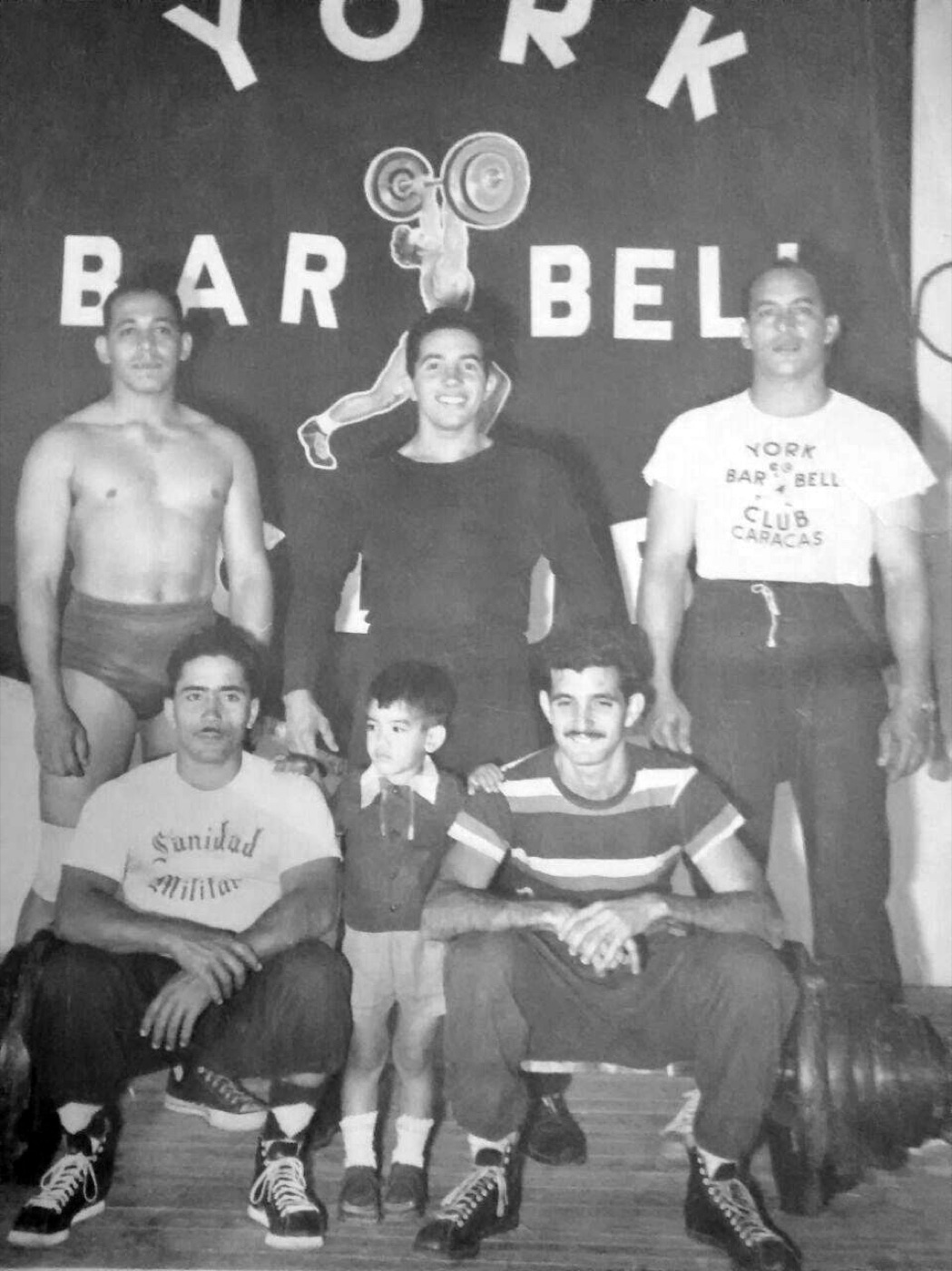
York Barbell Club at the 1949 World Weightlifting Championships, Caracas. Bob Hoffman's York organization helped create the American strength-sports infrastructure that early powerlifting grew out of. Photo by Nicolás Gavidia, scanned by Wilfredor, Wikimedia Commons, CC BY-SA 4.0.

World championships and the growth problem
The first official IPF World Championships took place in Harrisburg in 1973. Even then, the federation still had a balance problem: the IPF history says 43 lifters competed and 27 were American. The same source says the 1974 international match in Coventry and the first European Championships in Birmingham in 1978 helped move the sport toward a genuinely international structure.
Women's powerlifting followed later. The first Women's World Championships were held in 1980 in Lowell, Massachusetts, according to the IPF history page. Junior and Masters championships were added in the early 1980s: Masters in September 1983 in London, Canada, and Juniors in December 1983 in Florida.
That sequence matters because it explains the federation's current shape. The IPF is not only an open-class world championship. It is a pipeline:
- Sub-junior and junior categories.
- Open championships.
- Masters categories.
- Bench-only championships.
- Classic and Equipped divisions.
- Regional championships feeding world-level competition.
- National federations that nominate lifters and officials.
This is why the IPF feels different from a promoter-run federation. A lifter does not simply buy entry into an IPF Worlds as an individual. They normally move through a national federation, qualify under that federation's selection criteria, and compete as part of a national delegation. That creates bureaucracy, but it also creates continuity.
Classic and Equipped: the IPF's two powerlifting worlds
The IPF governs both Classic and Equipped powerlifting.
Classic is the IPF's term for raw/unequipped lifting. Under the technical rules, Classic lifters wear a non-supportive lifting suit and may use approved supportive items such as a belt, wrist wraps, and knee sleeves. Knee wraps are not part of Classic squatting. The point is not that the lifter is naked against the bar; the point is that the allowed equipment should not materially store and return force the way a squat suit or bench shirt does.
Equipped allows supportive gear: squat suits, bench shirts, deadlift suits, knee wraps, and other approved equipment. IPF Equipped lifting is single-ply, not multi-ply. This matters because the IPF's Equipped division is not the same thing as the most extreme multi-ply lifting seen in other federations. It is a stricter equipment environment with a narrower approved list.
The equipment list is not decorative. The IPF Approved List controls which manufacturers and models can be used in IPF-sanctioned competition. In 2025, the IPF even moved against several stiff knee sleeves, then reversed the immediate removal and allowed the affected sleeves through the end of 2026 while reviewing rules and approval procedures. That episode is a good example of the IPF's trade-off: when equipment is tightly controlled, equipment politics become part of governance.
For lifters, the practical lesson is simple: do not assume gym-legal means IPF-legal. A singlet, belt, knee sleeves, wrist wraps, deadlift socks, T-shirt, underwear, and supportive gear all need to satisfy the rules of the federation and meet. In the IPF, brand and model can matter.
What strict judging actually means
IPF judging is not magically perfect. It is still human judging. But the federation's rulebook makes certain technical standards non-negotiable.
The squat must reach legal depth: the top surface of the legs at the hip joint lower than the top of the knees. The bench press must include a controlled descent, a visible pause on the chest, a press command, and a rack command after lockout. The deadlift must finish with the lifter standing erect, knees locked, shoulders back, and no hitching or supporting the bar on the thighs.
The IPF technical rules page lists the current rulebook and translations. The 2026 rulebook implementation was postponed to March 1, 2026 after member feedback, which is a useful reminder that rulebooks are living governance documents, not timeless scripture.
Strict judging creates two effects.
First, IPF totals are more comparable. A 300 kg squat under strict depth rules is not the same claim as a 300 kg squat in a federation where high squats routinely pass. A paused bench is not the same claim as a soft touch-and-go bench. A clean deadlift is not the same claim as a pull with hitching.
Second, strict judging produces frustration. Lifters lose attempts on depth, pauses, soft knees, rack commands, and technical errors that would pass in a gym. That is not a bug in the system. It is the system. If the federation's value is standardization, red lights are the cost.
Anti-doping is the IPF's central dividing line
The IPF's strongest distinction from most powerlifting federations is not the rulebook. It is anti-doping.
The IPF states that it is a World Anti-Doping Code signatory and WADA Tier 1 compliant international federation. Its anti-doping page says athletes can be tested in competition or out of competition, anytime and anywhere, and that samples are analyzed at WADA-accredited laboratories. The IPF also says its anti-doping program is overseen through the Canadian Centre for Ethics in Sport (CCES).
This is a different regime from "tested" divisions in many non-IPF federations. In a casual tested meet, testing may mean a small number of in-meet urine tests. In the IPF system, international-level athletes can face out-of-competition testing, whereabouts obligations, Therapeutic Use Exemption procedures, biological passport considerations, and sanctions that follow the WADA Code.
That does not mean every IPF lifter is clean. No testing system proves that. IPF sanction notices still appear; in April 2026, for example, the federation announced anti-doping rule violations for lifters whose samples contained anabolic agents. The honest claim is narrower: the IPF is the major powerlifting federation most committed to Olympic-style anti-doping administration, and its performance distribution should not be compared casually with untested federations.
This is why an IPF Classic total and an untested raw total live in different contexts. The lifts may look similar on video. The regulatory environment is not similar.
The World Games, not the Olympic Games
Powerlifting is not on the Olympic program. The IPF has long pursued recognition and Olympic legitimacy, but the sport's main multi-sport platform is The World Games.
The International World Games Association page for powerlifting lists powerlifting as a founding member / IWGA member federation since 1980. The IPF's own welcome page says powerlifting has been on every World Games program since the first edition in 1981. For 2025 in Chengdu, the IPF announced that Classic would join Equipped at The World Games for the first time, with 128 athletes planned across Classic and Equipped categories. The World Games page identifies the 2025 disciplines as Classic and Equipped.
That matters because it shows the IPF's current strategic compromise. Olympic inclusion remains unresolved, but World Games participation gives IPF powerlifting a recognized international stage, qualification structure, national-team context, and a route for athletes to compete in a multi-sport event.
Why not the Olympics? There is no single official answer that explains everything. The likely obstacles are structural:
- Powerlifting is fragmented across many federations.
- The sport's public reputation is tied to pharmacology, even when the IPF itself runs strict testing.
- Olympic weightlifting already occupies the barbell-strength slot on the Olympic program.
- Powerlifting has long competition days and many bodyweight classes, which are difficult to fit into an Olympic schedule without compression.
- International depth is improving, but the strongest competitive base is still concentrated in particular regions and federations.
Those are not moral judgments. They are program-design problems. The IPF can keep improving governance, testing, broadcast, and international reach, but Olympic inclusion depends on the IOC's program choices, not only on the IPF's effort.
The current governance picture
The IPF changed leadership in 2025. Gaston Parage stepped down as president on March 11, 2025. Sigurjón Pétursson became interim president, then was elected IPF president at an Extraordinary General Assembly on June 11, 2025. The current executive committee page lists Pétursson as president, Dietmar Wolf as vice president, Robert Keller as secretary general, and Detlev Albrings as treasurer.
That transition is worth mentioning because federation articles date quickly. Governance is not a footnote in powerlifting; it shapes rules, calendars, anti-doping, equipment approval, eligibility, and national federation relationships. When an athlete says "I compete IPF," they are choosing the current governing structure, not an abstract historical brand.
The IPF's current public messaging emphasizes clean sport, governance, The World Games, student powerlifting, Special Olympics participation, livestream quality, and global development. That messaging is not accidental. It is how a federation argues that a strength sport often associated with gym culture can also function as a modern international sport.
What choosing the IPF actually means for a lifter
For a lifter, the IPF choice is practical before it is ideological.
Choose the IPF if you value:
- Strict technical standards.
- Drug-tested competition with WADA-code obligations at higher levels.
- National-team selection and world championship pathways.
- Classic lifting with controlled equipment.
- Single-ply Equipped lifting under a strict international rulebook.
- Records that are more comparable across countries and years.
- A federation connected to The World Games.
The trade-offs are real:
- Approved equipment can be expensive and restrictive.
- Attempt standards are less forgiving than many federations.
- National-team pathways can be political or bureaucratic.
- Anti-doping obligations can affect supplements, medication, whereabouts, and competition planning.
- Prize money is usually not the main reward.
- Athletes who want maximum all-time numbers often leave for untested or multi-ply-friendly federations.
That is why "IPF is the best federation" is too blunt. The more precise statement is: IPF is the best federation for lifters who want the most standardized, internationally governed, drug-tested version of powerlifting. It is not the best federation for every goal.
How IPF numbers should be read
An IPF result should always be read with five labels:
- Sex and bodyweight class.
- Age category.
- Classic or Equipped.
- Meet level and date.
- Whether the result is a total, a single-lift result, or a bench-only result.
This matters because IPF Classic and IPF Equipped are separate contexts. A 250 kg Classic bench and a 250 kg Equipped bench do not mean the same thing. A national record and a world record do not mean the same thing. A sub-junior result and an open result do not mean the same thing.
For ordinary lifters, the most useful comparison is not the all-time record table. It is distribution. Use the strength percentile calculator to compare your numbers against real OpenPowerlifting meet data, then use IPF records only as the far end of the map.
Criticisms that are fair
The IPF's strengths create its criticisms.
Equipment approval can look like a closed market. If only approved brands are legal, athletes may feel forced into expensive gear and manufacturers have to navigate federation approval. The 2025 stiff-knee-sleeve controversy showed how quickly equipment governance can affect athletes.
Judging can feel inconsistent. A strict rulebook does not remove human variation. Squat depth, bench pauses, and deadlift lockouts still involve judgment calls.
Anti-doping is not the same as proof of natural sport. A WADA-code system is much stronger than casual meet testing, but no system catches every violation. IPF results should be treated as tested results, not as metaphysical proof of natural potential.
The Olympic strategy can feel endless. The federation has spent decades building the kind of governance associated with Olympic sports, but powerlifting remains outside the Olympic Games.
Those criticisms are not reasons to dismiss the IPF. They are reasons to understand what kind of institution it is: a standards-first federation trying to govern a sport that often wants freedom more than standardization.
Where the IPF fits in powerlifting
The IPF is the establishment lane of powerlifting. It offers the clearest world-championship pathway, the strictest drug-tested framework among major federations, and the most standardized international rule environment. It is the federation where a total may be lower than an untested federation's total and still carry more regulatory weight.
If the WRPF and similar federations represent freedom, spectacle, and maximum numbers, the IPF represents constraint, comparability, and institutional legitimacy. Powerlifting needs both pressures. Without loose federations, the sport loses some of its experimental energy. Without the IPF, the sport loses its clearest claim to being a governed international discipline rather than a collection of strong gyms and record boards.
The IPF's future is not guaranteed to be Olympic. But its role is clear: keep the rulebook tight, keep the testing serious, keep the international calendar alive, and give lifters a platform where the total means exactly what the rulebook says it means.
Where to go next
- For the sport as a whole, read Powerlifting.
- For how the federation split grew out of the sport's history, read Powerlifting History.
- For training inside the three-lift system, read Powerlifting Training.
- For lift-specific technique, use the squat, bench press, and deadlift guides.