Powerlifting History: From Odd Lifts to a Global Sport
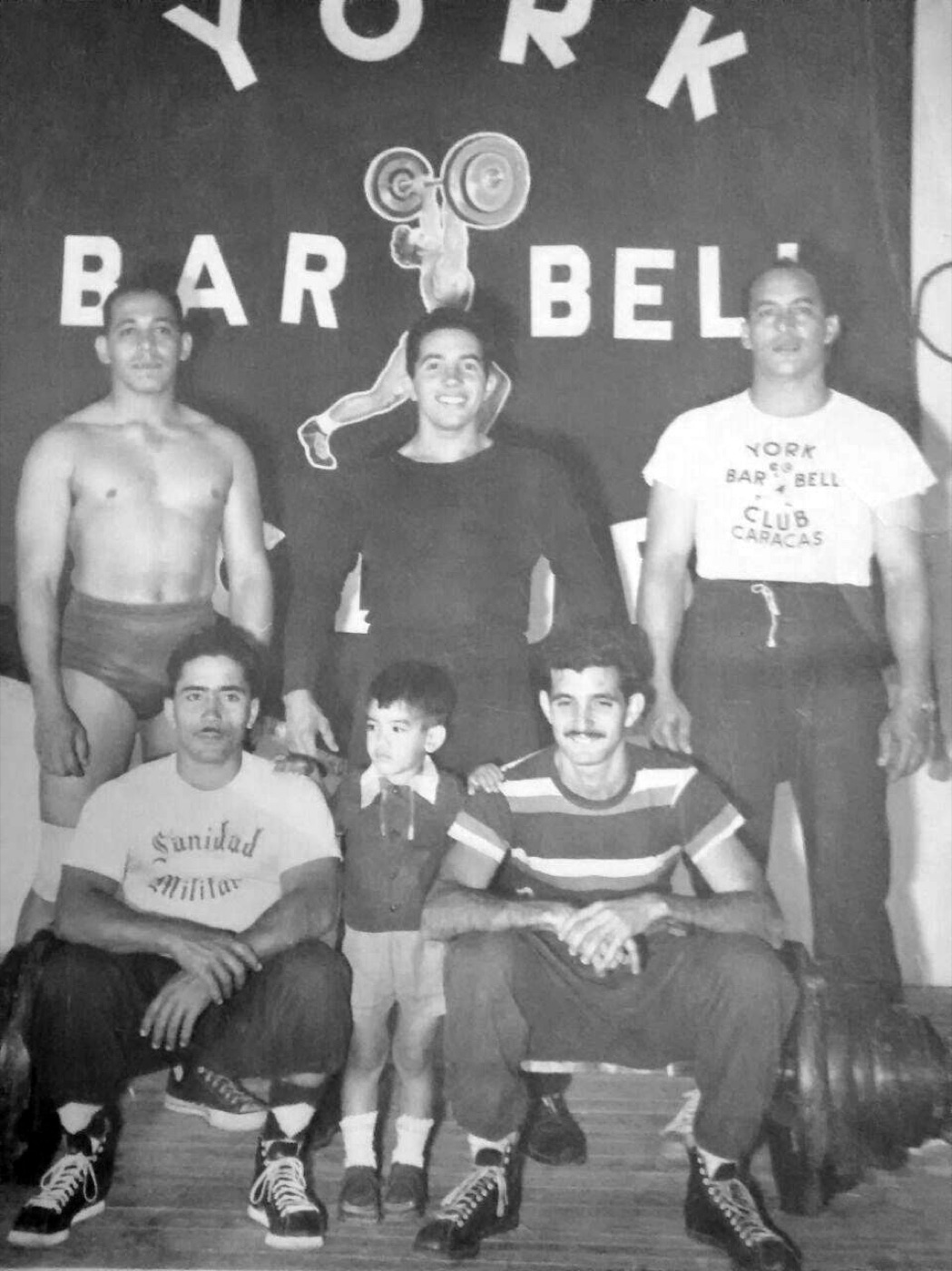
York Barbell Club at the 1949 World Weightlifting Championships, Caracas. Bob Hoffman's York organization dominated American weightlifting before becoming central to early American powerlifting. Photo by Nicolas Gavidia, scanned by Wilfredor, Wikimedia Commons, CC BY-SA 4.0.

Powerlifting did not begin as a cleanly designed sport. It began as a practical answer to a simple problem: strong people wanted to compete in lifts that were not the Olympic lifts. The squat, bench press, and deadlift already existed. Strongmen, bodybuilders, weightlifters, and gym lifters were already using them. What did not exist, until the 1960s and 1970s, was a stable rulebook that said: these three lifts, in this order, three attempts each, best total wins.
That is the useful way to understand powerlifting history. It is not the story of one inventor. It is the story of standardization. Loose "odd lift" contests became national championships. National championships became international championships. International championships forced rules, referees, weight classes, equipment definitions, drug testing, and eventually a split into raw and equipped versions of the sport.
This article is the longer historical companion to the main powerlifting guide. For the individual lift histories, see the squat, the bench press, and the deadlift.
How to read powerlifting history
The useful rule of thumb: never compare powerlifting numbers without asking which era, which rules, and which equipment category produced them. A 350 kg bench press in a bench shirt, a 350 kg raw bench press, and a 350 kg touch-and-go gym bench are not three versions of the same claim. They are three different rule environments.
That applies to the historical timeline too. Early powerlifting history is mostly a story of standardization: making the same lift mean the same thing in different gyms and countries. The equipped era is a story of technology: fabric changed what was possible and what had to be judged. The raw era is a story of accessibility: the sport became easier to understand from the outside because the lifts looked closer to normal gym lifting.
When a historical claim sounds too clean, check the category first. "World record" is only meaningful after you know the federation, equipment, drug-testing context, bodyweight class, and judging standard. Without those qualifiers, powerlifting history turns into folklore quickly.
Before powerlifting had a name
By the 1950s, the formal barbell sport was Olympic weightlifting: clean and press, snatch, clean and jerk. Those lifts rewarded speed, timing, mobility, and technical precision. They also punished older or heavier lifters whose shoulders, wrists, or hips could no longer tolerate the positions.
But gyms were full of other strength tests.
The squat had become a serious training lift after the strongman era and after lifters like Paul Anderson made heavy leg training impossible to ignore. The bench press, once a floor exercise and then an assistance lift for the Olympic press, was spreading through gyms as benches and uprights became normal equipment. The deadlift was the oldest idea of the three -- pick a heavy thing off the floor -- but it too needed a barbell, plates, and a defined lockout before it could become a contest lift.
These non-Olympic tests were often called odd lifts. The name sounds dismissive now, but it was literal: anything outside the Olympic program was odd. Depending on the country and the meet, odd-lift contests might include curls, presses, one-hand deadlifts, two-hands anyhow, partial lifts, squats, bench presses, and deadlifts. The format was alive, local, and inconsistent.
That inconsistency was the point and the problem. Odd lifts gave more people a way to compete, but they did not yet produce a sport that could travel. A lift done in York, Pennsylvania had to mean the same thing as a lift done in Birmingham, England. Until that happened, records were mostly gym mythology with paperwork.
York, Britain, and the first rule shape
The American center of gravity was York Barbell in Pennsylvania. Bob Hoffman, York's founder and the publisher behind Strength & Health, had built one of the most influential strength-sport institutions in the United States. York was primarily a weightlifting power base, but by the early 1960s it was also a natural host for the new strength contests that did not fit the Olympic template.
The IPF's own historical review describes an unofficial American Powerlifting Championships in York in 1964, followed by the AAU's first national championship in 1965, with the bench press, squat, and deadlift selected as the championship powerlifts. That detail matters: the first standardized American order was not quite today's order, and the sport did not instantly arrive fully formed. It had to be argued into shape.
Britain followed its own path. The early British "Strength Set" used the curl, bench press, and squat. By the mid-1960s the curl was dropped and the deadlift took its place, producing a format closer to modern powerlifting. The first British championships were held in 1966, and early international matches followed: Great Britain and France met in 1968 and 1969, though the format still differed from the modern sport.
The important pattern is that powerlifting was not only American. The United States had York, the AAU, and unusually strong heavyweight personalities. Britain had its own competitive scene and its own ideas about judging and lift order. Canada, Australia, Scandinavia, Japan, and other countries all had strong lifters before the IPF existed. The problem was not lack of strength. The problem was lack of shared language.
The unofficial worlds and the IPF founding
Bob Hoffman helped force the international question by hosting early "world" events in the United States. They were not official world championships in the modern sense. They were invitation-heavy, American-dominated meets, useful as spectacles but weak as international governance.
The 1972 event exposed the problem clearly. The IPF history notes that of the 80 contestants in the 1972 competition, 55 were American, and the lifts followed the American order: bench press, squat, deadlift. Europeans disliked that sequence. More importantly, everyone could see that a world sport needed more than a host with money and a strong American roster. It needed a federation.
On November 11, 1972, delegates met at the Zembo Mosque in Harrisburg, Pennsylvania, and founded the International Powerlifting Federation. Robert "Bob" Christ, the AAU weightlifting chairman, became the first IPF president. George Foster, Bill Gvoich, Howard Hamilton, Gilberto Gonzales, and Peter Fiore were elected vice-presidents, with Milt McKinney as general secretary. The first official IPF World Championships followed in 1973, again in Harrisburg.
The early IPF was still rough. The 1973 Worlds had 43 lifters, 27 of them American. The 1974 Worlds in York were also heavily American. But the federation now had a mechanism for improvement: congresses, elected officials, referee development, a rulebook, and international hosting. In 1975, Birmingham, England hosted a much stronger world championship with 16 countries represented, and the event became a model for later IPF meets.
That is the point where powerlifting stopped being an American odd-lift project and became a genuine international sport.
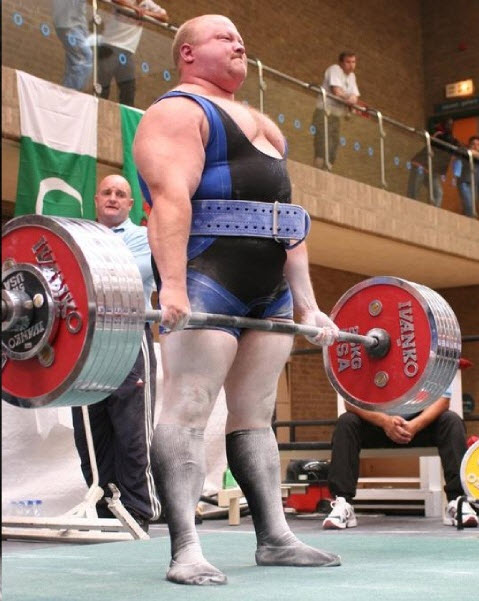
Dean Bowring in IPF competition kit at the 2005 Commonwealth Powerlifting Championships. By this era, the three-lift format, commands, equipment categories, and international judging structure were all mature. Photo by LiftingPictures.com, Wikimedia Commons, CC BY 3.0.

Women, juniors, masters, and the sport growing up
The first IPF World Championships were men-only. Women's powerlifting existed before the IPF gave it a full world championship, but it took until 1980 for the first Women's World Championships, held in Lowell, Massachusetts. That delay was not unique to powerlifting; women's strength sport fought the same cultural resistance that women's weightlifting, bodybuilding, and throwing events fought for decades.
Once women were added, the sport's structure expanded quickly. Masters and junior championships followed in the early 1980s. Regional championships developed. The European Powerlifting Federation, founded in 1977, gave Europe a stronger competitive calendar. Pan-American and Nordic championships gave lifters meaningful international competition below the world level.
The IPF also became connected to the multi-sport world. Powerlifting appeared at the first World Games in 1981 in Santa Clara, California, and the IPF later remained tied to the International World Games Association structure. That relationship matters because the World Games became powerlifting's highest Olympic-adjacent stage: not the Olympics, but a recurring international multi-sport platform for non-Olympic sports.
Drug testing entered the official story around the same time. The IPF history describes stimulant testing at the 1981 Worlds and IOC-style drug testing at the 1982 Worlds in Munich, with testing expected at future World Championships. The details of testing would change radically over the next forty years, but the direction was set early: the IPF wanted Olympic-style legitimacy, and that required anti-doping.
Equipment changes the sport
The first powerlifting equipment was ordinary by modern standards: belt, wraps, singlet, chalk, maybe a supportive suit that looked primitive compared with later gear. Then fabric technology changed the sport.
Knee wraps and squat suits made the squat more rebound-dependent. Bench shirts changed the bench press even more dramatically, storing elastic energy at the bottom and creating a new skill: lowering a bar that the lifter could not possibly press raw, touching it to the right place, then driving through a narrow groove. Deadlift suits helped less, because the deadlift begins from a dead stop, but they still changed hip position and start mechanics.
By the 1990s and 2000s, equipped lifting was no longer just "raw lifting plus gear." It was a different discipline. A great equipped bencher needed a different touch point, different triceps strength, different patience under load, and a team that knew how to fit the shirt. A great equipped squatter needed to understand straps, briefs, suit tension, wrap timing, and mono-rack technique. The lifter was still lifting, but the sport had become partly a contest of equipment mastery.
That produced real achievements and real backlash.
Equipped records exploded, especially in the bench press. At the same time, newer lifters looking from the outside often felt alienated. A squat suit or bench shirt made the sport less legible to someone coming from a normal gym. "How much do you bench?" had a meaning in gym culture. "How much do you bench in a triple-ply shirt?" was a different question.
Powerlifting never fully resolved that tension. It split around it.
Drug testing and the federation split
Equipment was one axis. Drug testing was the other.
The IPF's long-term strategy was to become the federation that could plausibly talk to the Olympic movement. That meant international governance, standardized rules, and anti-doping. Today the IPF describes itself as a World Anti-Doping Code signatory and WADA-compliant international federation. That is the strict end of powerlifting's regulatory spectrum.
Other federations made different choices. Some tested only at selected meets. Some offered tested and untested divisions under the same organizational umbrella. Some did not test at all. The split was not accidental; it reflected different answers to the same question:
Should powerlifting chase legitimacy, or should it chase the biggest possible numbers?
The IPF answer was legitimacy: strict judging, approved equipment lists, national teams, anti-doping, and a path toward the World Games and possible Olympic recognition. The untested-federation answer was performance freedom: fewer restrictions, bigger totals, more tolerance for lifter choice, and often more spectacle. Many lifters and fans moved between those worlds, but the record books stopped being comparable.
That is why modern powerlifting history cannot be written as one clean record progression. It is several histories running in parallel:
- IPF / tested powerlifting, where drug testing and stricter rules define legitimacy.
- Untested raw powerlifting, where many of the highest absolute raw totals happen.
- Single-ply equipped lifting, especially in the IPF Open division.
- Multi-ply equipped lifting, where the biggest equipped squats and benches live.
- Local federations, where most people actually begin competing.
The result is confusing from the outside, but internally it makes sense. Powerlifting has no single monopoly body with universal authority. It has federations, and federations are rule sets with cultures attached.
The raw renaissance
Raw powerlifting existed before it had a fashionable name. Early lifters were mostly raw by modern standards because supportive equipment had not yet developed. But by the late equipped era, "raw" had to become a category again.
The raw renaissance gathered force in the late 2000s and early 2010s. Internet video made lifting more visible. Gym culture cared about numbers that looked recognizable: belt, sleeves, wrist wraps, singlet, barbell. Newer lifters could watch a raw squat and understand it immediately. They could watch an extreme bench shirt and admire it, but they could not easily map it onto their own training.
The IPF formalized this shift with Classic powerlifting. The first IPF Classic World Cup / World Classic event was held in 2012 in Stockholm. In the years that followed, Classic became the most visible path into the IPF for many lifters. By the 2020s, the most talked-about lifters in the sport -- names like Jesus Olivares, Agata Sitko, Taylor Atwood, Russel Orhii, John Haack, Amanda Lawrence, and Tiffany Chapon -- were raw or Classic lifters, even when they competed in different federations.
The World Games eventually followed the audience. Equipped powerlifting had been part of the World Games since 1981, but Classic powerlifting was added to the 2025 World Games program, with both Classic and Equipped listed as disciplines. That was historically important: it acknowledged that the raw version of the sport was no longer a side category. It was central.
OpenPowerlifting made the shift even clearer. Once meet results from many federations were searchable in one public database, lifters could compare eras, categories, bodyweights, equipment types, and federations more honestly. The database did not solve every problem -- historical data is incomplete and federation rules differ -- but it changed the sport's memory. Records stopped living only in magazines, federation PDFs, and gym stories. They became queryable.
The Soviet and post-Soviet influence
The Soviet Union was not the founding center of international powerlifting in the way the United States and Britain were. But Soviet and post-Soviet strength culture shaped the sport deeply.
First, there was the broader Soviet sports classification system: objective ranks, published standards, and a bureaucracy that treated performance levels as part of state sport infrastructure. That system gave athletes a clear ladder from beginner categories through Candidate for Master of Sport, Master of Sport, and international titles. For more on that framework, see the Soviet sports classification article.
Second, Soviet and Eastern European training ideas filtered into powerlifting through weightlifting and track-and-field methodology: volume blocks, special exercises, long-term periodization, and more systematic control of intensity. Boris Sheiko became the most obvious powerlifting-specific example for Western lifters: high technical volume, submaximal work, and careful management of competition lifts. Louie Simmons and Westside Barbell drew from Soviet special-strength literature too, then adapted those ideas to American equipped powerlifting with box squats, bands, chains, and frequent variation.
Third, after the Soviet collapse, Russia, Ukraine, Belarus, the Baltic states, and other post-Soviet countries became major powerlifting cultures. They produced lifters, coaches, federations, and meet formats that still shape the sport. The modern federation landscape -- especially WRPF and streetlifting-adjacent strength culture -- cannot be understood without that post-Soviet contribution.
Why powerlifting is still not in the Olympics
Powerlifting has chased Olympic recognition for most of its organized life. It is easy to see why. The sport is simple to explain, dramatic at maximal loads, and globally practiced. It also already has an Olympic cousin in weightlifting, which proves that barbell strength can work on the Olympic stage.
But the Olympic problem has never been only "is powerlifting exciting?" The harder issues are governance, universality, anti-doping, event count, and overlap with existing Olympic weightlifting.
The IPF has done many of the things an Olympic-aspiring federation is expected to do: international championships, anti-doping, standardized technical rules, women's competition, youth/junior/masters categories, and World Games participation. Still, as of April 2026, powerlifting is not on the LA28 Olympic sport program. LA28 added sports such as baseball/softball, cricket, flag football, lacrosse, and squash, while weightlifting was retained; powerlifting remained outside.
There is also a confusing naming issue: Para powerlifting is in the Paralympic Games, but it is not three-lift powerlifting. It is a bench-press-only Paralympic sport governed separately from able-bodied three-lift powerlifting. That matters when people say "powerlifting is in the Paralympics." Yes, but not the same sport structure.
The more realistic near-term future is not the Olympics. It is better World Games exposure, better live broadcasts, better data, stricter anti-doping in tested federations, and continued growth of local and national meets.
What actually changed across sixty years
If you strip away the federation politics, powerlifting's history is the history of five big changes.
The lifts became standardized. The sport moved from odd-lift variety to a fixed three-lift total. That made records meaningful.
The judging became portable. Depth, pause, lockout, commands, jury decisions, and referee certification turned local gym feats into international sport.
Equipment became a separate variable. Supportive gear changed performance enough that raw and equipped had to become different categories.
Drug testing became a dividing line. Tested and untested lifting now represent different performance environments, not just different federations.
Data changed memory. OpenPowerlifting and modern meet databases let lifters look at distributions, not just legendary outliers. A 700 kg raw total at 90 kg means something different when you can see thousands of actual totals around it.
The sport is still messy. It still has too many federations, too many record books, and too many arguments about judging. But the core idea remains unusually clean: squat, bench press, deadlift, one total. That clarity is why powerlifting survived the odd-lift era, the equipment era, the federation wars, the raw backlash, and the Olympic disappointment.
It is not elegant in the way Olympic weightlifting is elegant. It is not chaotic in the way strongman is chaotic. It sits in the middle: standardized enough to compare, simple enough to understand, hard enough that every kilo has to be earned.
Where to go next
- For the sport as practiced now, read Powerlifting: A Practical and Historical Guide.
- For the individual lifts, read the squat, the bench press, and the deadlift.
- For the tested-federation structure, read the IPF federation article.
- For Soviet ranking culture and post-Soviet standards, read the Soviet sports classification system.
- To compare your own numbers against competing lifters, use the strength percentile calculator.
If you find a date, federation detail, or record claim here that should be corrected, send it in. Powerlifting history is unusually fragmented, and clean corrections are worth more than another recycled legend.