Soviet Sports Classification System: How Ranks Became Standards
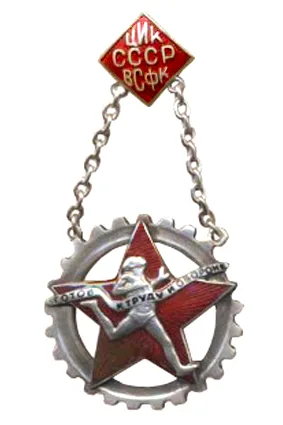
The GTO badge represents the population-level testing culture that preceded and surrounded formal Soviet sport classification. Source: Wikimedia Commons.

The Soviet sports classification system matters because it turned athletic progress into a ladder.
Instead of asking only "did you win?" the system asked a more repeatable question: "what standard did you meet?" A runner could chase a time. A weightlifter could chase a total. A swimmer could chase a result. A lifter in a later strength federation could chase Class III, Class II, Class I, Candidate Master of Sport, Master of Sport, or a higher title.
That logic is still visible across many standards tables used in Russia and other post-Soviet sporting contexts. It is also visible on this site. When you open a table for Powerlifting, Bicep Curl, Overhead Press, Powersport, or Streetlifting, the rank columns are not random labels. They come from a classification culture where performance levels are named, ordered, and tied to competition conditions.
This article explains the system without turning it into mythology. It covers GTO, EVSK, the difference between ranks and titles, why the model works, where it can mislead athletes, and how to read rank standards in modern strength sports.
The system in one sentence
The Soviet sports classification system was a centralized way to connect sport results with named achievement levels, from youth and adult ranks up to sport titles such as Candidate Master of Sport and Master of Sport.
The short version:
- GTO: broad physical-preparedness testing for the population.
- EVSK: the unified sports classification framework for competitive sport.
- Ranks: repeatable performance levels such as Class III, Class II, and Class I.
- Titles: higher honors such as Candidate Master of Sport and Master of Sport.
- Core idea: results should be measurable, comparable, and tied to a clear next step.
- Modern legacy: many post-Soviet sport and strength federations still use rank-style tables.
- Main caution: a rank only means what its rulebook, federation, event, and conditions say it means.
The useful mental model is this: GTO was about broad readiness; EVSK was about sport achievement. One system asked whether a population could meet physical tests. The other asked how athletes ranked inside specific sports.
GTO: the population layer
GTO stands for "Ready for Labor and Defense." The first Soviet GTO complex was approved in 1931. The official modern GTO history site describes it as a national system of physical tests, with early norms including running, jumping, throwing, pull-ups, rope climbing, swimming, cycling or similar practical skills, skiing, and other preparedness tasks.
GTO was not the same thing as elite sport classification. Its job was broader: create measurable physical-preparedness targets for a large population. That matters because it established a habit that later carried into sport culture:
- physical ability should be tested;
- tests should have standards;
- standards should be visible;
- progress should be recognized;
- age and category should matter.
The modern Russian GTO project still uses the same basic psychology: participants complete tests for bronze, silver, or gold distinction badges. The details changed, but the structure remains familiar: a person sees a table, finds their age group, performs the test, and knows where they stand.
That is the cultural root of many later standards systems. A number on a table is not just a number. It is a target, a status marker, and a training direction.
EVSK: the competitive sport layer
EVSK usually refers to the unified sports classification framework. In the Soviet period, the unified all-union classification organized sport results into named levels. In modern Russia, the Unified All-Russian Sports Classification continues the same broad function for officially recognized sports.
As of April 2026, Russian legal updates still treat EVSK as an active regulatory framework. ConsultantPlus, for example, reported the March 10, 2026 Ministry of Sport order approving a new Unified All-Russian Sports Classification for sports included in the Olympic Games program, registered by the Ministry of Justice on April 16, 2026 and published on April 20, 2026.
The details of any current official classification should always be checked in current federation and government documents. The important point for athletes is the structure:
- each sport has norms, requirements, and conditions;
- the same result may mean different things by sex, age, weight class, event, or discipline;
- some levels are ordinary sport ranks;
- some levels are sport titles;
- the conditions of performance matter, not only the number.
That last point is essential. A 200 kg total, a 10.8 second sprint, or a 60 kg curl is not self-explanatory. Was it done in the right event? Under the right rules? In the right age group? With the required level of competition? With the right judging? The classification mindset treats those questions as part of the result.
Ranks and titles
The most common confusion is the difference between a rank and a title.
In simplified strength-sport language, the lower and middle levels are usually shown as ranks:
- Class III
- Class II
- Class I
Many tables also include:
- Candidate Master of Sport (CMS)
- Master of Sport (MS)
- sometimes higher levels such as Master of Sport International Class (MSIC) or Honored Master of Sport (HMS) in official sport systems.
Do not assume every federation uses the exact same ladder. Some private strength federations adapt the language. Some use only a portion of the hierarchy. Some add elite or pro labels. Some publish standards that look like the old classification model but are not government titles.
The practical rule is simple: read the table label. If a federation table says "MS," it may be a federation classification target, not necessarily a state-awarded sport title. That distinction matters for accuracy.
On this site, rank columns should be read as standards inside the data source shown for that sport. They are useful for training and comparison, but they do not automatically imply official state recognition.
Why athletes like classification tables
Classification tables are sticky because they solve a real training problem.
Competition placement is unstable. An athlete can perform well and place low at a strong meet, or perform poorly and win a weak meet. A standard gives a second axis of meaning. It says: regardless of who showed up today, this result belongs to a named level.
That changes how athletes train.
A beginner does not need to think about national medals. They can chase Class III. Then Class II. Then Class I. Then CMS. Each step is close enough to understand and far enough to require work.
Good standards do three things:
- give beginners a first serious target;
- give intermediates a reason to keep training after easy progress ends;
- give advanced athletes a way to measure progress even when podium places depend on the field.
This is why the model appears far beyond Olympic sports. Strength federations, running clubs, swimming systems, online training platforms, and local competitions all create some version of the same ladder. The names differ. The psychology is similar.
Why strength sports adopted the model so easily
Strength sports are unusually compatible with classification systems because the result is already numerical.
In powerlifting, the total is measured in kilograms. In Olympic weightlifting, the total is measured in kilograms. In streetlifting, added weight or repetitions can be counted. In powersport, the press and curl combine into a total. In bicep curl standards, the result is the lifted weight under the rules of a variation.
That makes rank tables natural:
- choose sex;
- choose bodyweight class;
- choose federation;
- choose equipment category;
- compare result against the standard.
The table does not need to decide whether the athlete looked impressive. It needs valid attempts, a rulebook, and numbers.
There is a cost, though. When a sport is easy to reduce to numbers, athletes may forget the conditions behind the number. A raw total is not an equipped total. A drug-tested result is not the same record branch as a non-tested result. A strict curl is not an extreme curl. A streetlifting Classic result is not a Multilift result.
The Soviet classification habit is useful only when the context stays attached.
How to read a modern standards table
A good standards table should be read from left to right, not emotionally.
Start with the identity of the table:
- Which sport or lift is this?
- Which federation or data source?
- Which sex?
- Which bodyweight class?
- Which age division, if relevant?
- Which equipment category?
- Which rules define a valid result?
- Which rank column is the next realistic target?
Only after that should the athlete compare numbers.
For example, a lifter looking at powersport standards should not ask, "Is 150 kg good?" The better question is: "In which federation, bodyweight class, and equipment branch does a 150 kg press-plus-curl total sit?"
A streetlifter should not ask, "Is a 60 kg pull-up elite?" The better question is: "Was it a pull-up or chin-up, what bodyweight class, which federation, what rules, and was it drug-tested?"
A powerlifter should not ask, "What total is Master of Sport?" The better question is: "For which federation, sex, weight class, age division, equipment category, and year of standards?"
Classification is a map. It is useful only if you are looking at the right map.
What the system gets right
The classification model has several strengths.
First, it makes progress visible. An athlete who improves from Class III to Class II has evidence of development even without winning a major competition.
Second, it supports long-term planning. A coach can look at the gap between the athlete's current result and the next rank, then decide whether the limiting factor is technique, strength, bodyweight, event selection, or meet execution.
Third, it gives athletes shared language. Saying "CMS-level total" communicates more than saying "pretty strong," as long as everyone knows which table is being used.
Fourth, it respects sport specificity. A result is meaningful inside a discipline, not as a vague general fitness claim.
Fifth, it creates intermediate goals. That may be the most important point. Most athletes are not going from beginner to champion. They need a ladder with reachable rungs.
What the system gets wrong
The same strengths can become problems.
The first problem is table worship. Athletes may treat a rank column as proof of identity rather than a useful benchmark. A standard is feedback, not a personality.
The second problem is distorted incentives. If a title or rank brings status, selection advantages, or money, people may chase the label at the expense of long-term development.
The third problem is context collapse. A number gets copied without its federation, year, category, rulebook, or testing status. Once that happens, comparison becomes sloppy.
The fourth problem is training to the test. A standard can guide training, but it can also narrow training too much. Athletes still need robustness, technical development, recovery, and sport-specific decision making.
The fifth problem is historical exaggeration. The classification system was important, but it was not magic. Soviet sport also depended on state institutions, talent selection, coaching schools, political priorities, and sometimes coercive or unethical practices. A serious article should not turn a bureaucratic framework into a fairy tale.
How this applies on Sports Category
Sports Category uses standards tables because athletes need concrete targets.
The site covers sports and lifts where numerical comparison is central:
- Powerlifting: squat, bench press, deadlift, and total.
- Olympic Weightlifting: snatch, clean and jerk, and total.
- Streetlifting: weighted pull-up and weighted dip.
- Overhead Press: strict standing press standards.
- Bicep Curl: strict, classic, and extreme curl variations.
- Powersport: press plus curl total.
The classification logic helps organize those pages, but it does not remove the need for careful reading. Each table should be tied to a source, a federation context, and a rule definition.
If a number looks surprisingly high or low, check the category before judging it. The issue is often not the athlete. It is the table.
Practical lessons for athletes
Use rank standards as targets, not verdicts.
Pick the table that matches your actual competition context. Then identify the next rank above your current result. Estimate the gap. Translate the gap into training decisions.
For strength athletes, the process can be simple:
- Find your current valid competition result.
- Match the correct federation, sex, bodyweight class, and equipment category.
- Identify the next rank.
- Calculate the kilogram gap.
- Decide which lift or technical rule is limiting the result.
- Build a training block around that constraint.
- Test again under conditions close to the rulebook.
This is where the old classification idea remains genuinely useful. It keeps ambition concrete. It turns "get stronger" into "add 12.5 kg to the total under these rules."
Conclusion
The Soviet sports classification system survived as an idea because it solves a durable problem: athletes need clear standards.
Winning is valuable, but it depends on who enters the competition. A rank standard gives another kind of feedback. It tells the athlete where a result sits on a recognized ladder.
That ladder is never neutral. It depends on politics, institutions, rulebooks, categories, and the people who write the tables. But when used carefully, it is one of the most practical tools in sport: a clear next target.
The best way to use the classification mindset is not to romanticize it. Use it precisely. Find the right table, respect the rules, attach the context, and let the next standard guide the next block of training.
Sources and further reading
Reading time: ~13 minutes