Powerlifting Training: How to Build the Total
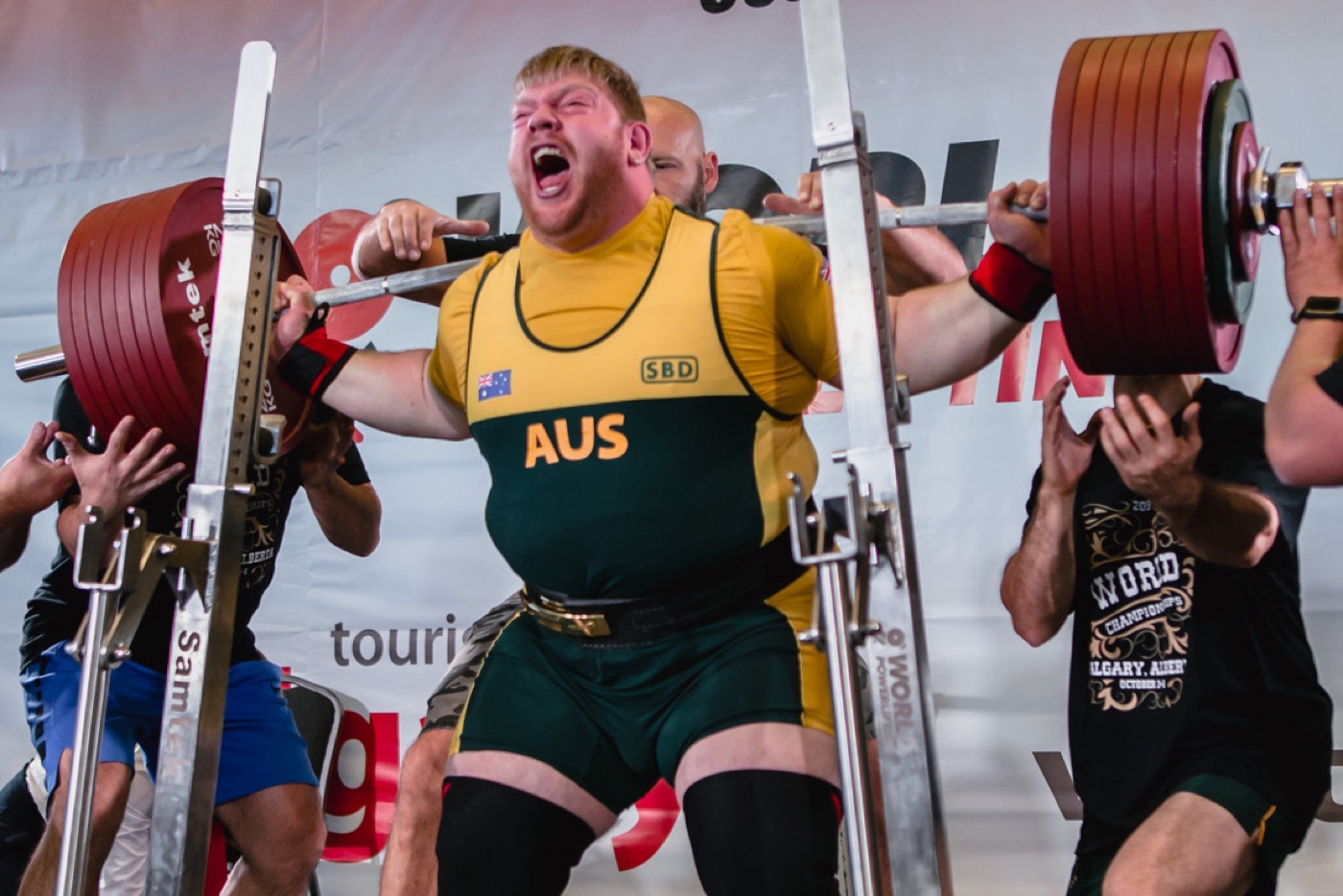
Tony Reinmuth squatting at the IPF World Powerlifting Championships, Calgary, 2020. Training for powerlifting has one concrete output: a larger competition total under the rules of a real meet. Photo by رادوینا, Wikimedia Commons, CC BY-SA 4.0.

A powerlifting program fails when it makes one lift look better on paper while the total stops moving. A lifter adds squat volume until the deadlift disappears. Another benches hard four times per week and wonders why the pec tendon feels like a warning light. A third "peaks" by testing maxes every Friday, then arrives at the meet already tired.
Powerlifting training is not just hard training on three barbell lifts. It is the management of stress across squat, bench press, and deadlift so the best versions of all three show up on the same day, under meet rules, with three attempts per lift. The unit of progress is not the best gym single you hit after a perfect warm-up. The unit is the total.
This guide is the practical follow-up to the powerlifting overview and the history of powerlifting. The individual lifts are covered in more detail here: squat, bench press, and deadlift. This article answers the bigger programming question: how do you organize those lifts across weeks, months, and meet cycles?
The total is the training target
Powerlifting rewards one number: best squat plus best bench plus best deadlift. That sounds obvious, but it changes how you should think about training.
A bodybuilder can chase local fatigue in one muscle group. A general strength trainee can add weight to whatever lift is moving that month. A powerlifter has to keep three specific competition lifts trainable at the same time. The squat and deadlift compete for hips, spinal erectors, adductors, grip, and systemic recovery. The bench competes less with the lower-body lifts, but high-frequency benching still uses shoulders, elbows, triceps, sleep, and attention.
The useful mental model is a budget. Every hard set spends recovery. Every accessory spends recovery. Every heavy single spends recovery. You do not get a moral bonus for spending the whole budget. You get a bigger total when the budget is spent on the work that improves the lifts and leaves enough capacity to adapt.
That is why a good program asks four questions before it asks for effort:
- What lift or phase is limiting the total? A slow deadlift off the floor requires different work than a bench that dies at lockout.
- What dose is enough to improve it? More volume helps until it stops helping and starts stealing from other lifts.
- How will fatigue be measured? Bar speed, RPE, weekly performance, joint pain, and missed reps all count.
- When does training need to turn into performance? A hypertrophy block, a strength block, and a meet peak should not look the same.
The ACSM progression model for resistance training is old but still useful as a basic map: beginners improve with a wide range of moderate loading; advanced lifters need more planned variation, higher specificity, and more careful intensity management. Powerlifting is the practical version of that principle.
Specificity: train the lifts, not just the muscles
Specificity means the training task should resemble the performance task enough to transfer. In powerlifting, the performance task is very specific: one judged squat, one paused bench press, one deadlift from the floor, all in a meet sequence.
That does not mean every set must be a competition single. It means the competition lifts need enough exposure that the skill stays sharp. A lifter who only squats to a high box may build hips and confidence, but the meet still requires depth. A lifter who only touch-and-go benches may build pressing strength, but the meet requires control on the chest and a press command. A lifter who only pulls from blocks may overload lockout, but the meet starts from the floor.
Useful specificity has layers:
- Competition lift: the exact lift under meet rules.
- Close variation: paused squat, tempo bench, deficit deadlift, close-grip bench, beltless squat.
- General strength movement: Romanian deadlift, front squat, dumbbell press, row, split squat.
- Capacity work: hypertrophy, trunk, upper back, hamstrings, shoulders, arms, conditioning.
The closer a lift is to competition, the more precisely it transfers and the more fatigue it tends to create. The farther away it is, the less directly it transfers but the easier it is to use for muscle, tolerance, or weak-point work. A good program uses all layers, but it changes the ratio over time. Farther from a meet, general work can be higher. Closer to a meet, competition-specific work should dominate.
Volume, intensity, and frequency
Three variables drive most programming decisions.
Volume is how much work you do. In practice, count hard sets first, then tonnage if needed. A set of five at 75% and a set of three at 85% are not equivalent, but both are meaningful hard work. Research on resistance training volume generally supports a dose-response relationship for strength and hypertrophy up to a point, with diminishing returns and individual variation. The useful coaching translation is simple: do enough hard work to grow and practice, but not so much that performance falls for weeks.
Intensity is load relative to maximum. Powerlifters need heavy work because the sport tests one-rep strength, but heavy work is expensive. Sets at 65-75% can build volume and skill. Sets at 75-85% are the productive middle for many strength blocks. Work above 85% is highly specific and useful, but it should be dosed deliberately. A lifter who lives above 90% often looks strong in training until the joint irritation and missed reps accumulate.
Frequency is how often a lift or pattern appears. Squat and deadlift are usually limited by systemic fatigue, so many lifters squat two to three times per week and deadlift one to two times per week. Bench press is less systemically costly, so two to four bench exposures per week are common. The question is not whether frequency is good. The question is whether the added exposure improves quality or just spreads the same fatigue across more days.
A reasonable starting point for raw lifters:
- Beginner: squat 2-3 times per week, bench 2-3 times, deadlift 1-2 times.
- Intermediate: squat 2 times, bench 3 times, deadlift 1-2 times, with one or two close variations.
- Advanced: frequency becomes individual. Some need more practice; some need less exposure and more recovery.
The important diagnostic is not how the template looks. It is what happens to bar speed, technique, and the next week's performance. If the third squat day makes every deadlift session worse, the third squat day is not productive volume. It is interference.
RPE and percentages solve different problems
Percentage-based programming uses a known or estimated max to prescribe load: 5 sets of 5 at 75%, 3 sets of 3 at 82.5%, singles at 90%. It is clear, measurable, and easy to plan. It also assumes that today's strength matches the number used to calculate the program.
RPE-based programming uses perceived effort. In powerlifting, the common version is "reps in reserve": an RPE 8 set means roughly two reps left, RPE 9 means one rep left, RPE 10 means no reps left. Mike Tuchscherer's Reactive Training Systems popularized this language in powerlifting because it gives lifters a way to adjust load when readiness changes.
Neither tool is superior in isolation. Percentages are good for structure. RPE is good for daily calibration. The strongest practical approach is usually hybrid:
- Use percentages to set the intended training zone.
- Use RPE to keep the set from drifting too easy or too hard.
- Use performance trend to decide whether the block is working.
Example: "top single at RPE 7-8, then 4 sets of 4 at 78% of that single." This gives the lifter a heavy but non-maximal exposure, then ties back-off work to the day's actual strength instead of to a stale max from three months ago.
This fails when the lifter cannot rate effort honestly. Newer lifters often call every hard set RPE 10 or every successful set RPE 7. In that case, percentages and simple rep targets are cleaner until the lifter has enough experience to estimate proximity to failure.
A simple year: accumulation, strength, peak, meet
Powerlifting periodization does not need mystical vocabulary. Most successful training years repeat four phases.
Accumulation builds the base. Volume is higher, variation is broader, and loads are mostly moderate. The goal is to add muscle, improve tolerance, clean up technique, and build work capacity. A lifter might use more paused squats, close-grip benching, Romanian deadlifts, rows, hamstring work, and high-rep accessories. The competition lifts stay in, but they are not the only work.
Strength turns the base into heavier specific work. Volume comes down slightly. Intensity rises. Competition lifts and close variations become the center of training. Sets of 3-6 dominate. Singles may appear, but usually as controlled practice rather than testing.
Peak reduces fatigue and raises specificity. The lifter practices competition commands, openers, and heavier singles. Volume drops. Accessories shrink. The goal is not to get fitter. The goal is to express strength already built.
Meet and recovery finish the cycle. After the meet, a lifter needs a short decompression period: less load, fewer judged-lift constraints, more attention to joints and movement quality. The next cycle should be planned from what actually happened, not from what the lifter hoped would happen.
A practical 16-week raw meet cycle might look like this:
| Weeks | Focus | Main work | What to watch |
|---|---|---|---|
| 1-5 | Accumulation | 4-8 rep work, close variations, more accessories | Joint tolerance, technique drift, appetite, sleep |
| 6-11 | Strength | 2-5 rep work, competition lifts, controlled singles | Bar speed, weekly e1RM trend, missed reps |
| 12-15 | Peak | Singles at RPE 7-9, opener practice, reduced accessories | Confidence without fatigue, command execution |
| 16 | Meet | Taper, weigh-in, attempts | Execution, not fitness |
This is not the only structure. It is the minimum useful structure: build, intensify, express, recover.
The main training families
Training systems are useful when you understand what problem they solve. They become harmful when copied as identity.
Linear progression
Linear progression adds weight to the bar session by session or week by week. A novice can squat three times per week and add load because the starting weights are far below their true capacity and the nervous system is learning quickly. Programs like Starting Strength and StrongLifts 5x5 use this logic.
Linear progression is excellent for beginners because it teaches the lifts, rewards consistency, and produces obvious feedback. It fails when the lifter is no longer a beginner. At that point, adding 2.5 kg every session is no longer a plan. It is a collision with biology. The right response is not to grind harder forever; it is to move to weekly progression, planned volume, and fatigue management.
Block periodization
Block periodization organizes training by emphasis: volume first, strength second, peak third. This is the most intuitive model for raw powerlifting because raw lifters usually need muscle, repeated technical practice, and enough heavy exposure to make meet attempts predictable.
The risk is over-separation. If the volume block never touches heavy weights, the lifter feels unprepared when intensity rises. If the peak block removes all volume too early, the lifter detunes before meet day. Good block training keeps a thread of specificity in every phase.
Sheiko-style volume
Boris Sheiko's influence on powerlifting is the idea that skill in the competition lifts can be developed through frequent, submaximal, technically precise practice. Sheiko templates are usually built around repeated exposures to squat, bench, and deadlift patterns at moderate intensities, with many sets and relatively few true grinders.
The benefit is technical consistency. The cost is volume tolerance. Sheiko-style training works best when the lifter has stable technique, predictable recovery, and enough patience to treat a clean set at 75% as productive work. It works poorly for lifters who turn every prescribed set into a max-effort event.
Conjugate / Westside
The conjugate method associated with Westside Barbell organizes training around max-effort work, dynamic-effort work, frequent variation, and targeted accessories. It was built in a world of equipped powerlifting, box squats, bands, chains, reverse hypers, and lifters who were already strong.
Its useful lesson is not "everyone should box squat with bands." The lesson is that variation can train weak points while reducing repeated stress from the same competition lift. A raw lifter can borrow this idea without copying the full Westside template: rotate close variations, attack a specific failure point, and keep the competition lifts frequent enough that skill does not decay.
Conjugate fails when a lifter uses variation to avoid specificity. If every squat variation is high, wide, box-supported, and banded, the meet squat will expose the gap.
RPE and autoregulation
Autoregulated training adjusts load or volume based on readiness. RPE is the most common powerlifting version. Velocity-based training is another version: bar speed helps estimate effort and fatigue, though it requires equipment and consistent setup.
Autoregulation is especially useful for intermediate and advanced lifters because readiness changes with sleep, bodyweight, work stress, and previous sessions. The risk is self-deception. A lifter who wants to train heavier can always call a set easier than it was. A lifter who fears load can always call it harder. RPE works when the training culture rewards accurate reporting more than heroic numbers.
How to program the three lifts
The three lifts do not respond identically.
Squat
The squat needs technical repetition and enough heavy loading to keep depth and bracing honest. Raw lifters often do well with two squat exposures per week: one competition-focused day and one variation or volume day.
A simple intermediate squat week:
- Day 1: competition squat, top single at RPE 7, then 4 x 4 at 75-80%.
- Day 2: paused squat or tempo squat, 3-5 sets of 3-5 reps at moderate load.
- Accessories: leg press or split squat, hamstring curl, trunk work.
The common error is too much low-back fatigue. If squats become good mornings and deadlifts stop moving, the program is not "hardcore." It is misallocated stress.
Bench press
The bench usually tolerates more frequency than the other lifts. Many raw lifters bench three times per week: one heavier competition day, one volume day, and one variation day.
A simple intermediate bench week:
- Day 1: paused competition bench, top single at RPE 7-8, then 4 x 4.
- Day 2: close-grip or feet-up bench, 4-5 sets of 5-8.
- Day 3: touch-and-go or Spoto press, 3-4 sets of 6-8.
- Accessories: rows, pulldowns, triceps, rear delts, rotator cuff work.
The bench fails when lifters only press. Upper back work is not cosmetic here; it stabilizes the shoulder and creates the platform for the press. Elbows and shoulders also need workload management. If every bench day is heavy and wide-grip, the joints usually complain before the total improves.
Deadlift
The deadlift is the most fatigue-expensive lift for many raw lifters. One heavy deadlift exposure per week is enough for a large number of intermediates. A second exposure can be lighter, more technical, or a variation.
A simple intermediate deadlift week:
- Day 1: competition deadlift, 3-5 sets of 2-4 reps, or one top single plus back-off triples.
- Day 2: Romanian deadlift, paused deadlift, or deficit deadlift, 3-4 sets of 4-6.
- Accessories: rows, hamstrings, glutes, trunk, grip if needed.
The deadlift fails when lifters treat it like the bench and keep adding frequency. Heavy pulls create systemic fatigue that can hide for two weeks and then show up as slow squats, poor sleep, and a deadlift that suddenly will not break from the floor.
Accessories should earn their place
Accessories are not filler. They should solve a problem that the competition lifts do not solve efficiently.
Good accessory categories:
- Upper back: rows, pulldowns, chest-supported rows, rear delts.
- Triceps: close-grip bench, dips if tolerated, extensions, pushdowns.
- Hamstrings and glutes: Romanian deadlifts, hamstring curls, hip thrusts, back extensions.
- Quads: front squats, high-bar squats, leg press, split squats.
- Trunk: weighted planks, side planks, rollouts, carries.
- Shoulder health: rear delts, external rotations, controlled overhead work if tolerated.
The mistake is accessory sprawl. A lifter adds six movements because a stronger lifter on the internet does them, then the main lifts suffer. The test is simple: can you explain what each accessory is supposed to improve, and can you remove it if it does not help? If not, it is probably clutter.
Peaking and attempt selection
A peak is not a last-minute strength phase. It is a fatigue-reduction phase with enough heavy practice to make meet attempts predictable.
Four to six weeks out, a lifter should have a realistic estimate of meet strength. Three weeks out, openers should be clear. An opener is not a personal record attempt. It is a weight you can make on a bad day, after a strict command, with travel, nerves, and a different bar. A common rule: opener around a clean triple or an RPE 8 single.
Second attempts usually build the total. They should be heavy but highly probable. Third attempts are strategic: a PR, a placing attempt, a record attempt, or a conservative number if the day is going poorly.
A basic attempt framework:
| Attempt | Purpose | Typical feel |
|---|---|---|
| First | Stay in the meet | RPE 7-8, no drama |
| Second | Build the total | RPE 8.5-9.5 |
| Third | Compete or PR | Depends on the day |
Meet week should be boring. Reduce volume. Keep movement practice. Sleep. Make weight without heroic dehydration unless you already have experience cutting. Pack equipment early. Read the federation rules. Know whether you need long socks for deadlift, what underwear is legal, what commands are used, and how weigh-in works. The IPF technical rules are the cleanest reference for strict meet procedure even if you compete elsewhere.
Diagnosing progress
A program should be judged by evidence, not by how serious it looks.
Track these:
- Competition-lift e1RM trend. Estimated one-rep max from controlled singles or rep work.
- Best repeatable work. For example, 5 x 5 at a load that used to be 3 x 5.
- Technique under load. Depth, pause control, lockout, bar path, command discipline.
- Fatigue markers. Sleep, appetite, joint pain, motivation, bar speed, missed reps.
- Bodyweight. Strength changes mean different things if bodyweight is moving.
OpenPowerlifting is useful for external calibration because it gives real meet results instead of gym folklore. Use the strength percentile calculator to place your lifts against actual competition data, then use training logs to decide what moves those lifts.
The most important diagnostic is the relationship between stress and response. If volume rises and performance rises after a normal delay, the lifter adapted. If volume rises and performance falls for weeks, the program exceeded recoverable capacity. If intensity rises and technique improves, the lifter is learning to express strength. If intensity rises and every single turns into a grinder, the peak is too heavy or too long.
Common ways powerlifting programs go wrong
Testing replaces training. Heavy singles are useful. Maxing out is different. If every week contains a true max, the program is mostly measuring readiness while draining it.
Volume is copied without context. A national-level lifter's bench volume may work because that lifter has ten years of adaptation, a bench-friendly build, and good recovery. Copying the set count without the context is a fast way to irritate elbows.
Technique work is too light to matter. Empty-bar drills can teach positions, but meet technique must survive load. A lifter who only practices pauses at 50% may still lose the pause at 90%.
Accessories become bodybuilding with a powerlifting label. Hypertrophy helps, but accessories should support the total. If the last hour of training is all pump work and the deadlift is falling, priorities are wrong.
Peaking starts too early. Eight weeks of low-volume heavy singles can make a lifter feel sharp for a while and flat by meet day. A peak should reveal strength, not consume it.
The lifter changes programs too quickly. A block needs enough time to show signal. One bad week is not proof that the method failed. Four bad weeks with worsening performance and fatigue is enough evidence to adjust.
A practical intermediate template
This is not a magic program. It is a readable structure for a raw lifter with stable technique who can train four days per week.
| Day | Main lift | Secondary lift | Accessories |
|---|---|---|---|
| 1 | Squat: top single RPE 7, 4 x 4 | Paused bench: 4 x 5 | Quads, trunk |
| 2 | Deadlift: 4 x 3 | Close-grip bench: 4 x 6 | Hamstrings, upper back |
| 3 | Bench: top single RPE 7-8, 5 x 4 | Tempo squat: 3 x 5 | Rows, triceps |
| 4 | Secondary bench: 4 x 8 | Romanian deadlift: 3 x 6 | Upper back, shoulders, trunk |
Run it for four to six weeks. Add load when bar speed and RPE allow. If a lift stalls, do not immediately change everything. First ask whether the problem is volume, intensity, technique, recovery, or exercise selection.
For beginners, this is too complex. Start with a simpler linear progression and learn the lifts. For advanced lifters, this is too generic. The more specific your weak points, injury history, and meet calendar become, the more individualized the program must be.
The long view
Powerlifting training is slower than online clips make it look. The first year teaches movement and tolerance. The second and third years build enough muscle and technical consistency that programming starts to matter. After that, progress becomes narrower: five kilograms on a total can be a successful block for an advanced lifter.
Classification standards are useful because they keep that process grounded. A lifter does not need to guess whether a 600 kg total at 83 kg is "good." The answer depends on sex, equipment, federation, and bodyweight, but the framework gives a real comparison. Standards are not destiny. They are a map.
The best program is the one that moves your total while keeping you healthy enough to keep training. It has enough specificity to transfer, enough variation to fix weak points, enough volume to build, enough intensity to express strength, and enough restraint to arrive at the meet ready.
That is the whole craft: build the lifts, protect the total, and let the platform tell the truth.
Where to go next
- For the sport, rules, equipment categories, and federation context, start with Powerlifting.
- For the historical background, read Powerlifting History.
- For lift-specific technique, use the squat, bench press, and deadlift guides.
- To compare your numbers against real meet data, use the strength percentile calculator.